Baleen
The WhaleBaleen, the long, hanging material that gives the bowhead whale’s mouth its cavernous appearance, became one of the whale products most closely tied to fashion. Reaching as much as fifteen feet in length, it was prized not only as a feature of an immense animal but as a material that could be taken, sold, and made to shape human bodies. Its commercial history links the scale of the whale to the demands of shore-based industries, and its eventual displacement by steel and plastic coincided with the decline of American whaling.
Material and Scale
The bowhead’s baleen is described as the longest of any whale’s, extending up to fifteen feet. In the whale’s huge mouth, it hangs like a ceiling-high mass, one part of the extraordinary scale that made the animal an object of both awe and exploitation. The bowhead could break through ice with its massive head; its capacity to survive in the Arctic did not, however, place it beyond human pursuit.
William Scoresby’s account gives a measure of the contrast between the animal and the people who hunted it. Of 322 whales whose capture he had personally witnessed or joined, he believed none exceeded sixty feet. He described a bowhead’s open mouth as large enough to contain a boat full of men. Such measurements made the whale legible to natural history and to commerce at once: the same body could be observed, described, and assessed for the materials it might yield.
From Whale to Shore
Baleen’s value belonged to a wider economy that converted whale bodies into goods for use ashore. In Britain, whaling expanded from ports including Whitby: over eighty years, fifty-eight ships made 577 voyages from the Yorkshire port, taking 2,761 whales along with seals and polar bears. The trade pursued whale oil for lighting and baleen for corsetry. Its methods placed the work close to the ice: British crews hunted from small boats, sometimes killed whales on the ice, and hauled them onto it for butchering. As many as a hundred vessels could form a cordon along the ice margin, while roughly one ship in ten failed to return.
In New Bedford of Whaling's Decline and Whale-Oil Industry Debates, the transformation of whale products into wealth could be read in the town’s grand houses. The account connects whale oil with marble and baleen with wood, describing the Atlantic, Pacific, and Indian oceans as the source of the materials and fortunes brought ashore. The exchange was not merely symbolic: the prosperity of the waterfront depended on the death of whales, and the products of their bodies entered buildings, clothing, and other industries.
Not all whale commodities came from baleen. In 1748, Jacob Rodriques Rivera introduced to New England a method for making fine candles from sperm-whale headmatter. It was heated, cooled, pressed in woollen bags, and refined through successive pressings; the remaining matter could ultimately be clarified into white wax. That process illustrates the larger pattern of extraction, while also distinguishing the liquid products of the whale’s head from baleen, which served a different market.
Fashion and the Decline of the Trade
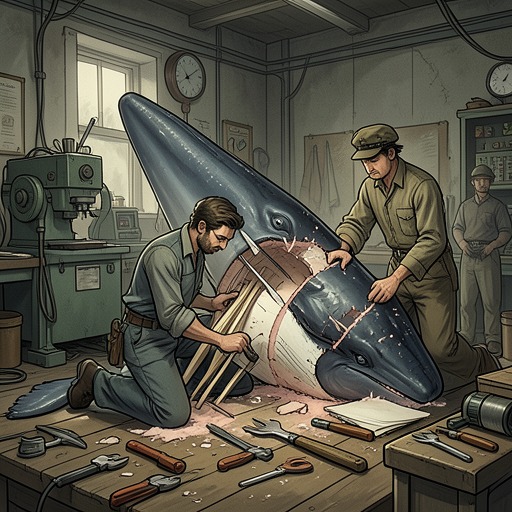
In the American whaling revival, bowheads of the western Arctic were killed for their large quantities of baleen, used to make corsets and hoops that altered the female form. The material’s value was therefore shaped by a fashion industry that demanded rigid supports. As steel and plastic supplanted whalebone in the early twentieth century, that market contracted. The change in clothing materials coincided with women’s movement away from constricting waists and ribcages, and appeared to offer the whales a corresponding reprieve.
The last whaler sailed from New Bedford of Whaling's Decline and Whale-Oil Industry Debates in 1924, after the trade had long been weakening. The material’s displacement did not by itself end whaling, but it removed a major use for whale products at a time when the industry was already in decline. Baleen’s history thus records a reversal: a feature that had made the bowhead commercially desirable became less valuable when human manufacture found substitutes.
The Whale as Commodity
Baleen’s passage from the mouth of an Arctic whale to the structure of a corset or hoop makes visible the distance between animal and commodity. In the market, the whale’s immense body could be divided into materials with separate destinations; in the Arctic, the bowhead remained a powerful, elusive animal whose survival depended partly on the remoteness of its habitat. Industrial hunting narrowed that distance by reaching into the ice and organizing fleets around extraction. The eventual replacement of baleen offers a pointed contrast: a manufactured material could change fashion, while the whale itself had borne the cost of supplying the earlier one.